
Skip to content

Puzzle Knowledge Center

How to Solve Cross Sudoku

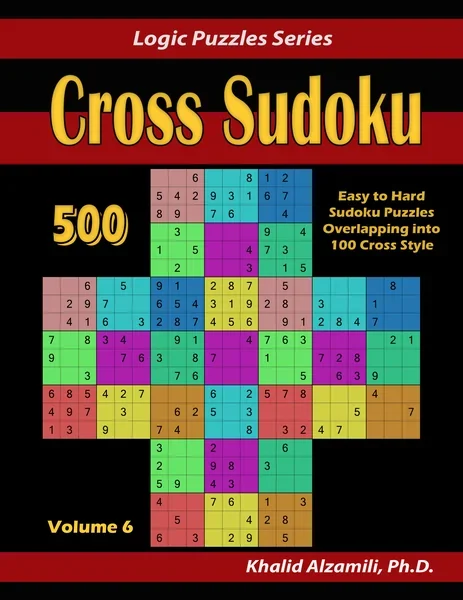
Cross Sudoku links overlapping Sudoku grids in a cross-shaped layout.

What Is Cross Sudoku?

Cross Sudoku is a linked-grid Sudoku variant in which several standard grids overlap to form a cross. Every component grid obeys the usual row, column, and region rules, while each shared cell must satisfy every grid that contains it.

The overlaps are the puzzle’s communication channels. A placement in an outer grid can remove candidates in the central grid and then continue into another arm. Efficient solvers therefore alternate between local Sudoku work and global overlap updates.

Rules

  1. Fill every empty cell with one digit.
  2. Each row and each column must contain every permitted digit exactly once.
  3. Each outlined region must also contain every permitted digit exactly once.
  4. Shared cells belong to every grid that overlaps at that position.

Step-by-Step Solving Method

  1. Scan rows, columns, and regions for a digit that has only one possible cell.
  2. Pencil in candidates when a placement is not immediate.
  3. Use singles, locked candidates, and pairs before moving to harder patterns.
  4. After every placement, rescan all affected units.

Professional Strategies

  • Track candidates consistently and remove them only when a rule proves they are impossible.
  • Use solved values and candidate restrictions in the central overlap to transfer progress between grids.
  • When stuck, switch from cell-based scanning to digit-based scanning across the whole grid.

Common Mistakes to Avoid

  • Guessing before exhausting logical deductions.
  • Checking rows but forgetting the special regions or variant constraint.
  • Leaving stale candidate marks after a placement.

Grid Anatomy and Terminology

Component grid
one complete Sudoku grid in the arrangement.
Central grid
the grid connecting the outer arms.
Overlap region
cells belonging to two component grids.
Transfer deduction
a restriction carried from one grid into another.
Inactive area
printed space that belongs to no component grid.

Beginner Techniques

  • Identify and label every component grid before entering candidates.
  • Start in the grid with the greatest concentration of givens.
  • When a shared cell is solved, update both grids immediately.
  • Check the row, column, and region membership of an overlap cell in each grid.

Intermediate Techniques

  • Use overlap boxes as bridges when a component grid stalls.
  • Combine candidate restrictions supplied independently by both grids sharing a cell.
  • Rotate through the four arms instead of overworking one grid.
  • Apply pairs and locked candidates locally, then propagate their effects through overlaps.

Advanced Strategies

  • Trace strong-link chains across a shared region and into a second grid.
  • Prioritize central placements because they often constrain more than one arm.
  • Audit shared candidates after every advanced elimination to prevent stale notes.
  • Use contradiction chains only after confirming every cell’s membership in the cross layout.

Systematic Solving Workflow

  1. Map the component grids and overlaps.
  2. Solve direct singles in the richest grid.
  3. Propagate each shared-cell change.
  4. Cycle through the arms and return to the center.
  5. Apply intermediate and advanced Sudoku patterns locally.
  6. Verify every component grid independently and confirm shared values agree.

Accessibility and Practice

Use strong borders around each component grid and a subtle secondary treatment for overlap regions. Large-print layouts should leave enough room for candidates and clearly distinguish inactive space.

Related Variations

  • Cross Sudoku belongs to the Gattai family of overlapping Sudoku.
  • Samurai Sudoku uses five grids in a different arrangement.
  • Some Cross Sudoku editions add diagonal or irregular-region rules only when explicitly stated.

Frequently Asked Questions

How many grids are in Cross Sudoku?

The exact number depends on the published layout; identify every complete component grid before solving.

Do shared cells have separate values?

No. A shared position is one cell and its value must satisfy both grids.

Where should I begin?

Begin in the component with the most direct singles, then transfer progress through overlaps.

Can I solve each grid independently?

Not efficiently. Overlap deductions are often required to restart a stalled grid.

Do normal Sudoku techniques work?

Yes, inside each component grid, provided shared candidates are synchronized.

What causes most errors?

Failing to update both grids after changing a shared cell.

Editorial Sources

Cross Sudoku Puzzle Books

Practice with 1 published Cross Sudoku book.