
Skip to content

Puzzle Knowledge Center

How to Solve Flower Sudoku

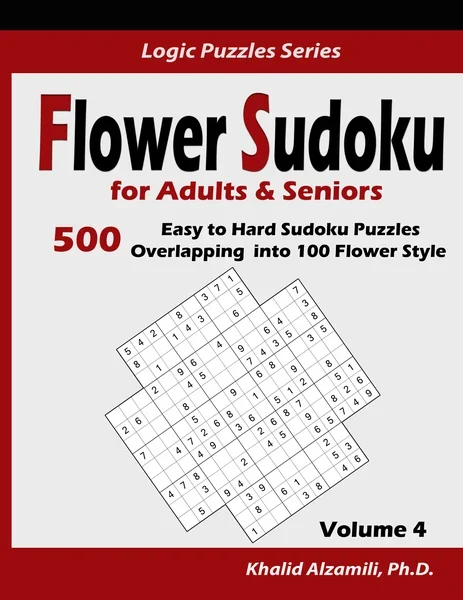
Flower Sudoku arranges linked Sudoku grids in a flower-like pattern.

What Is Flower Sudoku?

Flower Sudoku arranges linked Sudoku grids so that outer grids resemble petals around a central structure. Each printed component follows Sudoku rules, and shared cells transmit restrictions between neighboring petals.

Its visual symmetry can hide logical asymmetry: one petal may contain many givens while another depends almost entirely on overlap information. Professional solving moves inward and outward repeatedly rather than completing petals in isolation.

Rules

  1. Fill every empty cell with one digit.
  2. Each row and each column must contain every permitted digit exactly once.
  3. Each outlined region must also contain every permitted digit exactly once.
  4. Each petal or component grid follows its printed Sudoku regions, including all shared cells.

Step-by-Step Solving Method

  1. Scan rows, columns, and regions for a digit that has only one possible cell.
  2. Pencil in candidates when a placement is not immediate.
  3. Use singles, locked candidates, and pairs before moving to harder patterns.
  4. After every placement, rescan all affected units.

Professional Strategies

  • Track candidates consistently and remove them only when a rule proves they are impossible.
  • Work outward and inward alternately so overlap deductions propagate across multiple petals.
  • When stuck, switch from cell-based scanning to digit-based scanning across the whole grid.

Common Mistakes to Avoid

  • Guessing before exhausting logical deductions.
  • Checking rows but forgetting the special regions or variant constraint.
  • Leaving stale candidate marks after a placement.

Grid Anatomy and Terminology

Petal
an outer component grid or region in the flower layout.
Core
the central component linking the petals.
Overlap
cells shared by the core and a petal.
Propagation cycle
moving deductions from petal to core and into another petal.
Layout legend
the printed borders defining each active unit.

Beginner Techniques

  • Trace the borders of every petal and the central grid.
  • Begin where givens create immediate singles.
  • Copy every overlap placement into both affected candidate views.
  • Use ordinary row, column, and region scans within one component at a time.

Intermediate Techniques

  • Treat a nearly solved overlap as a launch point for its neighboring component.
  • Compare candidate sets contributed by the core and petal.
  • Rotate around the flower after each group of placements.
  • Use local pairs and locked candidates to create overlap eliminations.

Advanced Strategies

  • Build chains that pass from one petal through the core to another.
  • Choose deductions with the greatest propagation potential, especially central shared cells.
  • Use synchronized candidate audits before applying wings or coloring.
  • When several petals stall, search the core for a restriction common to multiple overlaps.

Systematic Solving Workflow

  1. Map all petals, core units, and overlaps.
  2. Solve direct placements in the richest petal.
  3. Update the core after every shared change.
  4. Move to the next petal and repeat.
  5. Apply advanced Sudoku patterns only on synchronized candidates.
  6. Verify each component and each overlap separately.

Accessibility and Practice

Petal borders, overlap shading, and inactive areas must remain visually distinct without relying on color alone. Large-format printing is strongly recommended for candidate notation.

Related Variations

  • Flower layouts differ between publishers, so the border legend is authoritative.
  • Samurai, Sohei, and Cross Sudoku are related overlapping-grid variants.
  • Extra diagonal constraints apply only when printed.

Frequently Asked Questions

Is every Flower Sudoku layout identical?

No. The number and arrangement of component grids may vary, so follow the printed borders.

What is a petal?

It is an outer component connected to the central structure through shared cells.

Should I finish the center first?

Not necessarily; alternate between the richest petal and the core.

Do overlap cells belong to both grids?

Yes, and their candidates must satisfy both sets of peers.

Why does progress stop in one petal?

It may require a candidate elimination transferred through the core from another petal.

How should I verify the solution?

Check every component as a complete Sudoku and confirm all shared cells agree.

Editorial Sources

Flower Sudoku Puzzle Books

Practice with 1 published Flower Sudoku book.