Skip to content

Puzzle Knowledge Center

How to Solve Samurai Sudoku

Samurai Sudoku combines five overlapping Sudoku grids into one connected challenge.

What Is Samurai Sudoku?

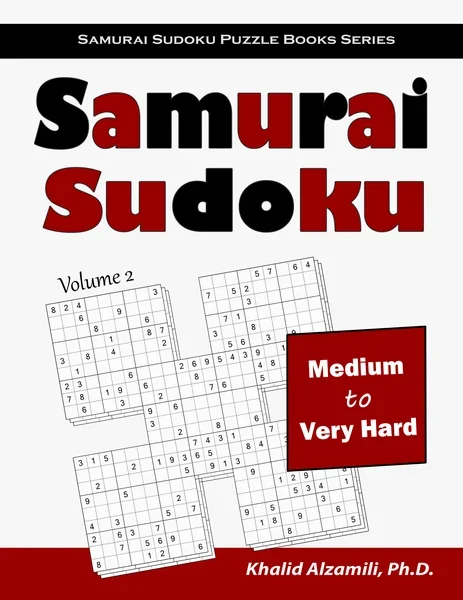
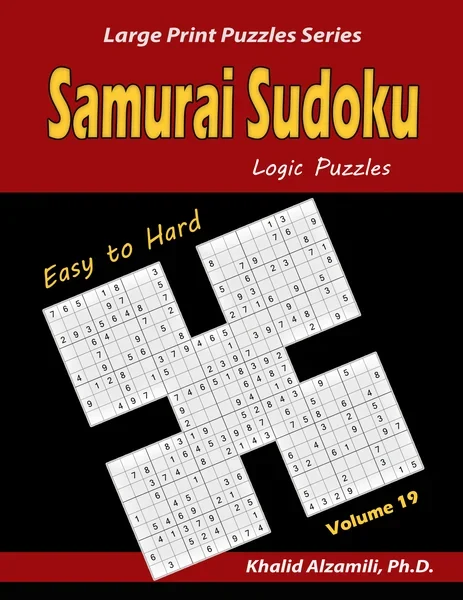
Samurai Sudoku combines five 9×9 Sudoku grids: four corner grids overlap the four corner boxes of a central grid. The shared cells are not duplicated; every value must satisfy both component grids at the same time.

The challenge is organizational as much as logical. A solver who treats the five grids as independent misses the main engine of progress. Shared boxes transmit deductions from one grid to another, so a stalled corner grid may become solvable after work in the center.

Rules

  1. Fill every empty cell with one digit.
  2. Each row and each column must contain every permitted digit exactly once.
  3. Each outlined region must also contain every permitted digit exactly once.
  4. Every component grid follows Sudoku rules, and shared cells must satisfy both grids.

Step-by-Step Solving Method

  1. Scan rows, columns, and regions for a digit that has only one possible cell.
  2. Pencil in candidates when a placement is not immediate.
  3. Use singles, locked candidates, and pairs before moving to harder patterns.
  4. After every placement, rescan all affected units.

Professional Strategies

  • Track candidates consistently and remove them only when a rule proves they are impossible.
  • Solve into overlap zones from both directions; a candidate removed in one grid is removed in the other.
  • When stuck, switch from cell-based scanning to digit-based scanning across the whole grid.

Common Mistakes to Avoid

  • Guessing before exhausting logical deductions.
  • Checking rows but forgetting the special regions or variant constraint.
  • Leaving stale candidate marks after a placement.

Grid Anatomy and Terminology

Component grid
one complete 9×9 Sudoku.
Central grid
the middle grid overlapping all four corners.
Overlap box
a 3×3 box shared by two component grids.
Transfer deduction
a candidate change in one grid that constrains the other.
Inactive space
printed gaps that belong to no grid.

Beginner Techniques

  • Label the five component grids mentally or on paper.
  • Begin with the grid containing the most givens.
  • Update both grids whenever an overlap cell is solved.
  • Keep candidates inside their correct component rows and columns.

Intermediate Techniques

  • Use a completed or nearly completed overlap box to restart the neighboring grid.
  • Track overlap candidates from both sets of row and column peers.
  • Rotate between grids instead of forcing progress in one stalled area.
  • Apply pairs and locked candidates within each component grid.

Advanced Strategies

  • Build chains that pass through an overlap from one grid into another.
  • A strong link in the central grid may eliminate a candidate in a corner grid through their shared cell.
  • Prioritize deductions with high propagation value: central-overlap placements affect the largest structure.
  • Maintain separate candidate audits for each component grid while treating shared cells as one state.

Systematic Solving Workflow

  1. Survey all five grids and choose the richest starting area.
  2. Solve singles and basic locks locally.
  3. Propagate every overlap change immediately.
  4. Cycle clockwise through corner grids, returning to the center between them.
  5. Use advanced techniques only after candidate synchronization.
  6. Verify each of the five grids independently, checking shared cells once.

Accessibility and Practice

Large paper size and clear separation between active grids and empty space are important. Use distinct but subtle shading for the four overlap boxes and provide room for candidates.

Related Variations

  • Gattai Sudoku is the broader family of overlapping Sudoku arrangements.
  • Sohei and Flower Sudoku use different multi-grid layouts.
  • Some Samurai puzzles add diagonal or other constraints; those are not implied by the standard layout.

Frequently Asked Questions

How many grids are in Samurai Sudoku?

Five standard 9×9 grids: four corners and one central grid.

How many cells are shared?

Four 3×3 boxes are overlaps, so each shared box belongs to two grids.

Where should I start?

Start where givens create the most singles, then use overlaps to transfer progress.

Can I finish one grid before touching another?

Sometimes, but rotating through overlaps is usually more efficient.

Do shared cells have two values?

No. Each overlap is one physical cell satisfying both grids.

Why do candidate errors spread quickly?

An incorrect overlap candidate contaminates two component grids, so synchronize notes immediately.

Editorial Sources

Samurai Sudoku Puzzle Books

Practice with 31 published Samurai Sudoku books.