
Skip to content

Puzzle Knowledge Center

How to Solve Sohei Sudoku

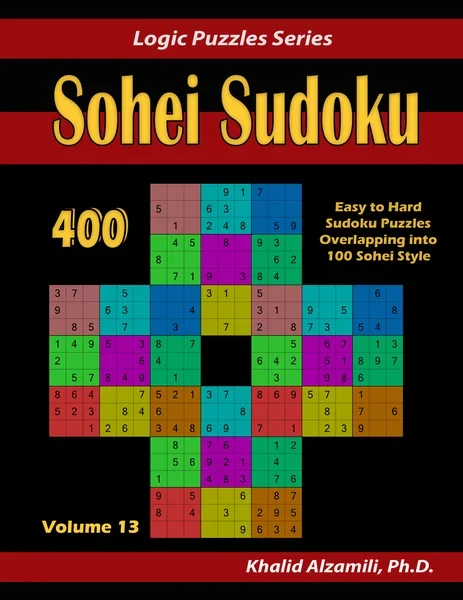
Sohei Sudoku links four overlapping Sudoku grids in a compact arrangement.

What Is Sohei Sudoku?

Sohei Sudoku links four standard Sudoku grids in a compact overlapping arrangement. Every grid keeps its own rows, columns, and boxes, while shared cells must satisfy two grids simultaneously.

With fewer components than Samurai Sudoku, Sohei is visually smaller but still demands disciplined candidate synchronization. The best progress often comes from solving toward an overlap in one grid and then using that information to unlock its neighbor.

Rules

  1. Fill every empty cell with one digit.
  2. Each row and each column must contain every permitted digit exactly once.
  3. Each outlined region must also contain every permitted digit exactly once.
  4. Every component grid follows standard Sudoku rules and agrees on shared cells.

Step-by-Step Solving Method

  1. Scan rows, columns, and regions for a digit that has only one possible cell.
  2. Pencil in candidates when a placement is not immediate.
  3. Use singles, locked candidates, and pairs before moving to harder patterns.
  4. After every placement, rescan all affected units.

Professional Strategies

  • Track candidates consistently and remove them only when a rule proves they are impossible.
  • Prioritize overlaps because each confirmed value constrains two grids at once.
  • When stuck, switch from cell-based scanning to digit-based scanning across the whole grid.

Common Mistakes to Avoid

  • Guessing before exhausting logical deductions.
  • Checking rows but forgetting the special regions or variant constraint.
  • Leaving stale candidate marks after a placement.

Grid Anatomy and Terminology

Component grid
one of the four complete Sudokus.
Overlap box
a shared 3×3 region between neighboring grids.
Transfer path
the direction in which a deduction moves across overlaps.
Shared candidate
a candidate restricted by peers in two grids.
Outer box
a region belonging to only one component.

Beginner Techniques

  • Label the four component grids.
  • Begin in the component with the most givens.
  • Update both candidate systems after solving a shared cell.
  • Use ordinary singles before adding extensive pencil marks.

Intermediate Techniques

  • Use overlap boxes to transfer pairs and locked candidates.
  • Rotate between grids whenever local progress stops.
  • Intersect candidate lists supplied by both components.
  • Prefer overlap deductions because they produce progress in two grids.

Advanced Strategies

  • Build chains that enter an overlap and continue in a neighboring grid.
  • Use shared strong links to eliminate candidates outside the overlap.
  • Audit candidates in all four grids before coloring or forcing-chain work.
  • Rank deductions by propagation value instead of difficulty.

Systematic Solving Workflow

  1. Map all four grids and shared boxes.
  2. Solve singles in the richest component.
  3. Propagate overlap changes immediately.
  4. Cycle through the remaining components.
  5. Apply advanced techniques to synchronized candidates.
  6. Verify all four complete grids and every overlap.

Accessibility and Practice

Use bold component borders and subtle overlap shading. Provide generous candidate space and ensure inactive areas cannot be mistaken for puzzle cells.

Related Variations

  • Sohei belongs to the Gattai family of overlapping Sudoku.
  • Samurai uses five grids; Cross and Flower use different connected layouts.
  • Diagonal or irregular Sohei rules apply only when printed.

Frequently Asked Questions

How many grids does Sohei Sudoku use?

The standard form uses four overlapping 9×9 Sudoku grids.

Are overlap cells duplicated?

No. Each shared cell has one value that must satisfy both grids.

Where is the best starting point?

Start in the component with the most singles, especially near an overlap.

Can normal Sudoku techniques be used?

Yes, inside each grid, with shared candidate restrictions included.

Why rotate between grids?

A deduction in one overlap may unlock a neighboring grid that previously had no direct move.

How is Sohei checked?

Verify each of the four component grids independently and confirm every shared box agrees.

Editorial Sources

Sohei Sudoku Puzzle Books

Practice with 1 published Sohei Sudoku book.